
A community effort to preserve the last urban forest near the University of Arkansas has gathered support, hoping to educate and spread knowledge on the significance of one of the last forests in Fayetteville as it faces development. The developer says it has goals to create a “Conservation Development” on the property it acquired, and the test of time will tell its future success
On a wet and cold February night at a Fayetteville City Council meeting, there is a group of yellow-green vested protestors lined up along the back of the council room. They are carrying signs that say “Save Markham Hill” as well as holding up two banners too. The variance in zoning they’re protesting is to reduce the amount of space units are required to have from their doorstep to the end of their driveway, however to them it isn’t about the magnitude of the variance. They are present to make it clear that they plan to protest each rezone and variance from Specialized Real Estate Group.
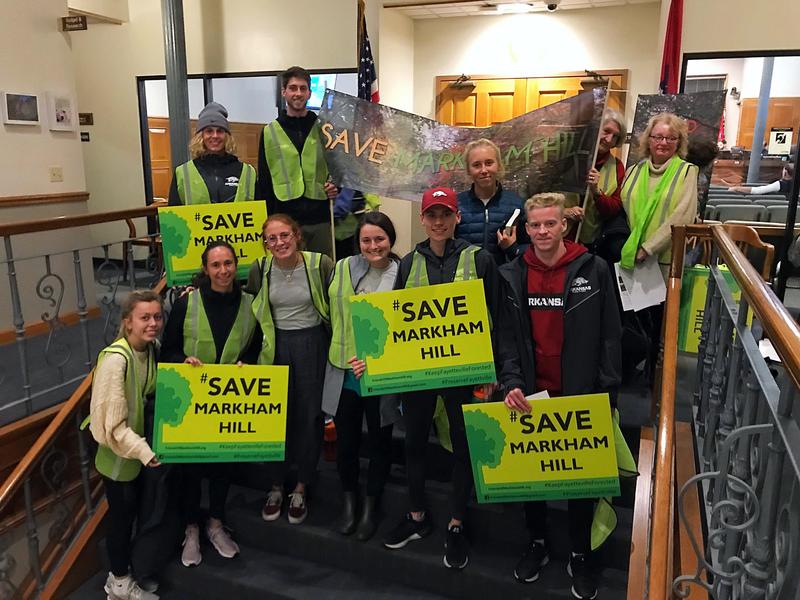
Each vest is a resident, runner, neighbor, or friend of Markham Hill. Markham Hill is one of the last urban forests they consider to be a significant part of the historic context of Fayetteville. They call themselves the “Friends of Markham Hill”.
Although Phase one of the development has already passed they continue to support the preservation of Markham Hill. They are all prepared to give speeches about the importance of preserving the urban forest, even though the City Council has approved several other variances on the lot since 2018.
The first to step up to the podium during the public comment period is Katie Simon, a resident of Fayetteville near the Markham Road neighborhood. She is given 5 minutes to make her case for the City Council to not approve another variance in the zoning.
“Specialized Real Estate Group’s request for a variance in their phase one development plan for Markham hill should be denied, page 2 of the city council meeting memo from the meeting January 7th, 2019 stated that as part of the 2018 amendment the applicant included 20’ landscape buffers for Markham Road, and 20’ setbacks for throughout the area too. The intent of this is to promote lot layouts that allow dwellings to be “nestled” within tree canopy and respectful of the existing neighborhood context,” Simon said.
“And that’s a quote, let me repeat that, respectful of the existing neighborhood context. The existing neighborhood context is wooded, it is one house per one to five or more acres with setbacks greater than 20’. Most if not all houses on Halsell, Markham and Sang adjacent to SREG’s proposed phase one development on Markham Hill are 50 to 250 feet per setback.” Simon continued.
“Our existing neighborhood context also includes our city’s largest intact, urban forest East of Interstate 49. This forest is a critical habitat not only to wildlife, natural flora of our ozark region, but a natural sanctuary for the people of our city both past and present.” Simon said.
“The existing neighborhood context has sheltered and preserved a history that is not only important to the people of the university and the city of Fayetteville, but to our great state of Arkansas, and our nation as a whole. It was here, where Evangeline Pratt Archer wrote a letter to J. William Fulbright to begin the efforts to save the Buffalo.”
“This is the birthplace of the Ozark Society, and our nation’s first national river. It was Evangeline Pratt Archer, and Joy Markham’s wish that this place be conserved for future generations of conservationists. The variance should not be approved otherwise SREG is reneging on their promise to the neighborhood, the people of Fayetteville, and the city. The city council seems to be bending over backwards to allow SREG to destroy Markham Hill with development.”
“We know of the civic projects elsewhere where SREG promised conservation development and then broke their promises by cutting down most of if not all of the trees and replacing the natural land with impervious surfaces. With a tree here and there left. Surrounding neighborhoods were aghast.”
Simon began to ask questions intended for the City Council.
“Number 1, if a developer has demonstrated promise-breaking, misrepresentation, and alternate facts, do the planning commission and city council have to approve the rezones and variance permits et cetera just because the applications were filled out correctly and no code or ordinance was broken, if so this is a very sad situation for the future of Fayetteville. With so many letters and speeches from the public, why are the Fayetteville residents being ignored over and over again?
Over, and over again the City officials appear to be showing favoritism to the developers and discriminating against the residents who don’t make money from the development. I believe this is unjust and unrighteous. Favoritism to the money-makers and discrimination to the non-money makers.”
“Question number 2, Is this what the city wants history books to say about the Fayetteville city government during this time period?”
“Question number 3, How are the planning commission and city council going to correct their complicity in helping Seth Mims, representing SREG, break his sworn promises in federal court during the Archer bankruptcy trial in February of 2016, and we have a copy of the attached public transcript from Seth Mims testimony, the following concerns the 72-acres West half of Markham Hill, which was rezoned, and we have a copy of the rest of those questions, I hope you’ll take time to answer them. We are not against infill, we are against infill that destroys our last remaining intact urban forest–”
“Time” Fayetteville City Clerk, Kara Paxton said.
“Thank you. Who else would like to address this?” Mayor Lioneld Jordan said.
After several more speeches advocating to not allow the variance in zoning from residents, many of them from the neighborhood near Markham Hill, it was time for the city council to vote. The variance was passed, and the protestors walked out of the City Council meeting.
When looking at their website for their plans on Markham Hill there’s a border shown of the entirety of the property. There is also an outline for the potential of a bike trail connection drawn as well. Although Specialized agreed to provide the full plans for the first phase, and overall plan of development on Markham Hill, the plans weren’t sent following the interviews prior to publication.
The Proposed Plans from Specialized Real Estate Group:

(Specialized Real Estate Group, Markham Hill Phase 1, Location)
The exhibits provided in the city council meeting were more detailed about what Specialized was filing a variance for, as well as the overall plan.


“Markham Hill’s urban forest tree-cover and natural habitat must be preserved and protected because of its nature, wildlife, environmental benefits, history, University of Arkansas championship cross country and track training area, archaeology, and Native American sites. The Friends of Markham Hill would like to persuade the City officials to stop the proposed development of the 144-acre Markham Hill property and help make it a preserve in the middle of Fayetteville for future generations,” Lisa Orton, writer of the Weekly Markham Hill Moments of History, and one of the Leaders of Friends of Markham Hill said.
Orton was born and raised in Fayetteville on Halsell Rd, adjacent to Markham Hill. Her family’s horses were pastured in one of Joy Pratt Markham’s wooded horse pastures, the one beside her family’s home. Lisa, her mother, and her brothers rode horses on the Markham Hill trails, often stopping by to say ‘Hi’ to Joy and Evangeline Archer in the 1960-70s. Lisa’s mother, Marion Orton, worked with Evangeline Archer and others in the Ozark Society to help save the Buffalo River from being dammed and to make it the first National River in the United States in 1972. Orton’s mother, Marion Orton was also the Mayor of Fayetteville from 1975 to 1976. Orton’s mother considered Evangeline Archer her mentor when it came to ‘water quality’ while working with the League of Women Voters.
Orton also publishes the “Weekly Markham Hill Moments in History” every Monday. She’s published them since July 3rd of 2019. Each moment shares details about a wide variety of topics, like the Pratt Waterman Archer family, stories from runners that were once on the University of Arkansas cross country and track teams training on the trails, a miniseries called “The Blue and the Gray that was filmed on the land, and the Native American archeological sites.
After graduating college and she worked in Maryland for 30 years for the Department of Defense as a cryptanalyst and software developer. She retired and returned to Fayetteville several years ago and lives on Halsell Rd in the house she lived in as an infant and toddler. Orton wanted to get away from urban life and its, traffic, exhaust, noise, cement, and little-to-no urban forestry.When she moved back, she learned that the Archers had filed for bankruptcy but knew nothing of the details. Then she learned that SREG, with Robert M Dant’s out-of-state financial backing, bought the land in early 2016.

History of Markham Hill:
Cassius and Maggie Pratt bought a house and approximately 40 acres on West Mountain, now called Markham Hill, in 1900. They had six children in total. Their four sons moved away. Their two daughters, Joy Pratt Markham and Evangeline Pratt Waterman Archer, inherited the 40-acre homestead. They added over 200 acres on Markham Hill to the Pratt family land over the years. Joy’s only child died and so she willed her land and money to the University of Arkansas for preservation and the arts. Evangeline’s only living child, son Julian Pratt Waterman Archer, inherited her land.

Julian owned the Pratt family land from 1980 until early 2016 when he lost the 144-acre Markham Hill property in a bankruptcy trial that the Friends of Markham Hill believe is suspicious. Robert M Dant, an out-of-state investor, purchased the 144-acre Markham Hill property through the local developer Specialized Real Estate Group (SREG) whose CEO and President are Jeremy Hudson and Seth Mims. Robert M Dant is the owner of RMD properties, who uses Specialized Real Estate Group to represent their interests, and project development planning. In the Markham Planned Zoning District (PZD) Bill of Assurance presented to the neighbors in the Markham Hill and University Heights neighborhood, RMD properties is listed as the current owner of the property. RMD Properties shares an address with SREG.


Discussion with Julian Pratt Waterman Archer and his time living there:
I spoke on the phone with Julian Pratt Waterman Archer during an interview with Trey Marley, a resident in the Markham Hill neighborhood. Archer now lives in Des Moines, Iowa, so I couldn’t speak with him in person.
Julian grew up in Fayetteville in the cottage that his parents built in 1929. He was born in the Fayetteville Hospital in 1938. When he was ready to go home they went to the cottage that is still standing on Markham Hill today.
Julian’s parents were Evangeline Pratt, and Julian Waterman. Waterman was the founder and first dean of the University of Arkansas law school. His father died 1943 when he was young, but Evangeline Pratt Waterman then met Laird Archer, who was the head of an NGO where he was based in Athens Greece, so Julian moved to Greece.
After living in Athens for five years Archer then returned to Fayetteville. He returned to public school here, and went to Leverett School, Fayetteville Jr. High, Fayetteville High, and the Univeristy of Arkansas.
As stated before, he inherited some of the property on Markham Hill in 1980 following his mother’s death, and lived there until 2016.
How ownership changed hands:
Driving west up Markham Rd from Razorback Rd, you will note the change from residential homes to Markham Hill woods. You will then see a rugged Evangeline Lane on the right and a section of Sang Ave on the left where a wooded horse pasture and small red barn are situated. Evangeline Lane was named after Evangeline Archer who lived in the house now called Evangeline’s Cottage on the right as you continue up Markham Rd. She built, and designed the house in 1929 and died there in 1979. The cottage has been on the National Registry of Historic Places since 1999.
When you reach the top of the hill, you will see Julian and Jane Archer’s log house in the woods on the left, and then the Pratt Inn and the Event Barn with its wooded horse pasture. They are surrounded by over 200 acres of intact urban forest on all sides of the mountain. The Pratt Inn is a boutique hotel with seven rooms.
In 2005 Julian Archer received permission from the City to build the Pratt Inn over the family home that Cassius and Maggie Pratt bought in 1900, even though its commercial status was not compatible to a residential community.
Julian, the City, and the neighborhood agreed that Julian could build the Pratt Inn if the 72 acres on the east side of Markham Hill remained natural and undeveloped, providing a buffer between his small commercial establishment and the wooded low-density residential neighborhood. A promise the City broke in 2018 when they approved SREG’s rezoning requests.
Several years after the Pratt Inn and Event Barn were built, Julian and Jane Archer had their 144-acre property appraised. It came to around $5 million.
The Archers filed for bankruptcy January 15th, 2015 under chapter 11 bankruptcy, which would allow for the Pratt Inn and Event Barn to continue operations while exploring options for ways to forgive their debt.
The 144-acre property was then purchased by SREG for $3.1 million, reported originally by the Northwest Arkansas Democrat Gazette, in February of 2016.
The Friends of Markham Hill are curious how SREG was able to buy the 144-acre property for $3.1 million when it would have appraised for approximately $5-6 million.
Additionally, they are curious why the trustee of the property did not advertise the sale of the land in a manner in which the City of Fayetteville, the surrounding neighborhood, and Fayetteville residents could learn about it.
This would have given them the opportunity to gather conservationists to purchase this intact urban forest with its ecosystem, historic land, early 20th century archeology, and Native American sites for what they want to be a preserve for future generations to enjoy.
I asked Julian personally how the property exchanged ownership from him to Specialized Real Estate Group. When he inherited the land his mother willed him in 1980, he began to negotiate with the University of Arkansas to redraw property lines. “ We negotiated for six years until we finally reached a settlement, trading land value for value, dollar per dollar, and gave the University one consolidated piece of property on the northwest side of the hill.” Archer said.
“My wife and I decided to create an inn and an event space, the barn. The barn that’s up there, I designed and built, and then we created the Inn, which saved the Pratt house. It was falling apart, and when I say it was falling apart, it was really falling apart.” Arched added.
“Then we had some minor technical problems which allowed Simmons bank to institute some bankruptcy actions against us.” Archer said.
Archer said that he was then deceived by the bank, and they asked him when he could pay them for the debt he owed. “I said fine, I went in to make the payment, and they said we refuse the money, what they wanted was to get the property, they wanted us just to turn the property over to them so they could sell it for a huge profit.” Archer said.
Julian then filed for bankruptcy with some protection, but unfortunately he lost due to the lawyer he had chosen. Julian then explained how he tried to raise money to get the bank out of the picture.
“We created what’s called a Planned Zoning District, it’s called a PZD, and we put 72 acres into that PZD, it’s the 72 acres when you walk across the pasture, and get to the far side where the pasture ends, and the woods begins.” Archer said.

“That’s the western side of the PZD, from that line, and there’s actually a pretty good fence along there. There’s 72 acres to the east, which was a PZD, there was 72 acres to the west of that line which was not in a PZD, it was zoned (r4) 4 houses per acre by the city.” Archer said.
“We decided to sell those 72 acres to raise the money to get the bank out of the picture, and we put it up for sale, and a number of people were interested, but the best bid came in from Specialized.” Archer said. “So the best bid for the 72 r4 acres was from Specialized, we were going to sell that to them.” Archer said.
Archer reiterated “Now, the purpose of all this was to get Simmons bank out of the picture. The sale price for those 72 acres was over a million dollars, that would have reduced our debt to Simmons bank dramatically, we still would have owed them some money, and we could have come up with it by selling something else.”
Archer added that [Specialized] said “they had investors who would put up the money to buy the PZD, pay off Simmons bank, completely out of the picture, and then they would refinance it for us (Julian Archer), we would then owe them 35 to 40% of what we owed to Simmons bank.”
“In other words, the sale of the land the 72 (r4) acres would get rid of the bulk of our debt, and the investors would refinance the rest of what we owed.” Archer said.
“That was the deal we had, it was an understanding, it was verbal, he (Seth Mims) swore to this under oath in federal court, on February 4th, 2016, he was going to keep it zoned as it was, and he swore to that under oath at federal bankruptcy court, so we believed that he going to get his financers, pay off the bank, and sell the property back to us at that price which would refinance it.” Archer said.
“What happened was, as soon as we sold the property to him, he went silent, and wouldn’t respond to a phone call, to visits, to emails, anything, and within one week he turned around and sold it to his investors.” Archer said.
When asked if there was any unfinished business, Archer said “In addition to the furnishings of the inn which were purchased for business purposes, we have family items in there, paintings, awards, our piano, and the old farm implements on the walls in the barn. There’s a huge number of personal items that we stuck around for decorative purposes, and we’re trying to get those back.”
Archer added that their (SREG’s) lawyers said that they could have them back, but they are having difficulties with correspondence.
“You don’t go to bed at night reading your mortgage contract, no one does.”
“One of the things that always strikes me, is the reported sale price of $3.1 million, that just seems like such a steal for all of that up there.” Trey Marley said.
“The price was not determined by an appraisal, not by value, it was determined by the cost it to get Simmons bank out of the picture.” Archer said. Archer said they only wanted to get Simmons bank out of the picture, they would refinance, and they would have sold the 72 acres on the west side of the property zoned 4 units per acre voluntarily.
Archer said that normally in bankruptcy court, when a person files, they begin appraising whatever assets are to be sold, Archer said that they didn’t feel that was necessary in this case.
Archer said that the remainder owed on the property would have been roughly $800k, and they would refinance on a loan for that amount from SREG, the sale of the 72 acres would have brought their debt down enough for them to be in good withstanding credit from the (Simmons) bank, he would have been left with $800k outstanding, SREG would finance it, and they would create a mortgage contract for the Archer’s to eventually own the land containing the Inn, barn, and cottage.
Archer then said elaborated how he felt this happened with Simmons bank. “When people get mortgages, most of the time they don’t hire lawyers to get their opinion” on the clauses contained within the contracts. “You can say I want to change this clause, and the wording of another clause, the bank drew up those papers, not you.” Archer said. “You trust that the bank, [when] you make your mortgage payments, they subtract so much per month from the principal, they take the interest they give you a statement of the interest, you figure that they’re doing things right, and you don’t worry about the clauses.” Archer said. “You don’t go to bed at night reading your mortgage contract, no one does.” Archer said. “We signed it and trusted the bank” Archer said.
“There were some technical defaults on our part, yes we couldn’t dispute them, but a normal bank would say ‘oh, if you straighten this out in three months, we’ll ignore it’ that’s exactly what we had with Simmons, we met with officials, they said okay you can get this straightened out.” Archer said. While they were working to reorganize, and pay off Simmons they didn’t know that the bank would end up declining their payment, Archer said. “At the end of three months, I went in with a check to the bank, and they said we won’t accept it. Here I am settling the dispute, and they refuse to take the payment.” Archer said.
Archer said emotionally, the hardest part of this is behind him, “We lost everything in 2016, we lost my grandparents house, my parents house, our own house, we lost all that land, we don’t even set foot there.” Archer said that they are still working to get their personal property there back.
The Developer Specialized Real Estate Group (SREG) and their future plans

Phase one of Specialized Real Estate Group’s plan to develop Markham Hill has already passed in the city council.
(PZD Master plan from the Bill of assurance provided to the City of Fayetteville by SREG)
The introduction to the Markham Hill phase one page on their website says “In the center of one of the most rapidly growing regions in the nation, within one of the most desirable neighborhoods, and just a stone’s throw away from the state’s largest university sits a rare opportunity. Markham Hill is a serene 144-acre property containing woodlands and pasture — largely undeveloped with the exception of a boutique country inn, a historic cottage, and an event barn. A recent rezone opens the land to a mix of uses, including a neighborhood of around 500 homes, expanded hospitality, restaurant, and commercial uses — all surrounded by acres of majestic forest. Specialized Real Estate Group is pursuing plans for a conservation community which offers the best of both worlds: a secluded woodland retreat in a thriving cultural center.”
Specialized Real Estate Group has built properties like “The Cardinal” on West Center street, they have designed the complex “Sterling Frisco” bordered by Lafayette, West Street, Maple Avenue, and the “Eco Modern Flats” located off of Hill Avenue.
They are large apartment complexes all located near downtown Fayetteville, which is also close by the University of Arkansas campus. Their motive when building a new development, according to SREG’s official website is “Healthy neighborhoods create connections between neighbors, businesses, and nature, Specialized Real Estate Group focuses on opportunities for infill development in Northwest Arkansas. Infill development strengthens the fabric of our community by putting people within reach of services, workplaces, and transportation infrastructure like bike paths. Connecting people with businesses, nature, and each other is vital to healthy communities.”
The final sentence on their “Projects” page is “Because of our strong commitment to customer service and stewardship, our projects yield a strong return on investment—not just for direct investors, but for the neighborhoods and communities in which they are located.”
I spoke with the Marketing, and Outreach coordinator Sarah King, who said she was happy to clear up any misconceptions on the project. King also worked at the Botanical Garden of the Ozarks, and has a background in landscape architecture. She says that in working for Specialized its made her think of things in the bigger picture. “There are some very vocal local residents who are expressing their opinions, very strong opinions, and in many ways are misrepresenting our goals.” King said. “We had very focused meetings with different subsets of the neighborhood and discussed the idea of a conservation neighborhood, and that is our approach to this development, and the Markham Hill property that we own.” King said.
King said Specialized’s development is going to extend the existing neighborhood, and preserve permanently the most sensitive habitats on the hill. “When the property was rezoned, to present it simply, 44 acres were put in a zoning designation that would allow zero units per acre to be developed.” King said it was Specialized’s intention to keep the pasture on the hill as a centerpiece of the neighborhood.
“In many ways where other generations might have bought a house because it looked out on a golf course, our idea is that people now would really like to have a house that is near woodland, and natural areas.” King said.
“We know that we’ve got our work cut out for us, because Markham hill is so centrally located in Fayetteville, many of the landscapes are quite degraded, that’s something that many of the experts that we’ve worked with have educated us about, and what they mean by that is either through poor management of the land, or the establishment of invasive plants, a lot of the existing woodland in particular is considered degraded, by that they mean that natural forest can’t regenerate under those conditions.” King said.
“We’re left with having to go in and with our understanding of wanting to preserve what natural space there is, but also to reclaim a lot of that landscape. Our consultants have told us this is not something that happens in year one, but really you can see the environment rebound in year seven, eight, and nine.” King added. Some of the consultants Specialized worked with are the Northwest Arkansas Land Trust, Dr. J.D. Willson, a reptile, and amphibian biological expert at the University of Arkansas,
King said parts of the landscape on Markham hill are almost entirely one or two species. “You’ll have a chinese privet as well as a bush honeysuckle.”
The city of Fayetteville’s Urban Forestry committee recently included bush honeysuckle with the Bradford pear bounty program renewal after a successful inaugural year of the program. Bush honeysuckle is considered an invasive plant species in the region.
“This is very nuanced, what we assume when we look and we see green we say ah, that’s beautiful natural area, but unfortunately that’s not necessarily true. What we observe in Fayetteville, right now in February on into March, we see Fayetteville gets green and it’s already starting to get green.” King said
“If you travel out of town, if you go to Devil’s den, if you go to the Buffalo river its not green there, and the reason is our native plants, they don’t green up this early, and you see illustrated really clearly that these invasive plants have. They come out early they shade the ground, and then they make it so baby oak trees, baby dogwood trees, all of the little spring flowers that you might see when you hike the Buffalo, they don’t get a chance, because they don’t ever get any sun.” King said.
“It’s hard to look at the argument that it’s no place to build homes when some of the people making that argument who themselves have built homes, or are living in a houses that someone built. Its hard to see that the characteristics of the land change at the property line, you know, on my side of the property line is a fine place for a home to be, but on your side of the property line it should be untouchable, that’s really hard to understand.” King said. She then began to explain that the city of Fayetteville is growing rapidly, simultaneously with the growth of the University of Arkansas.
“That growth year over year has slowed, but there was a decade where the university grew by 10,000 students, and in that time there wasn’t a lot of housing developed.” King said. She said what Specialized took notice of was that in more affordable neighborhoods where there more affordable houses it would be full of students. “That meant that there would be a house that wasn’t available for a young family starting out to live in Fayetteville, so we saw Fayetteville become unaffordable for young families starting out.”
King acknowledged there are critcisms of the development of student housing, some of which Specialized has been involved in. “With The Cardinal, when I talk to people from town, I ask them to understand this and see this the same way that I do.” King said.
“Markham is such a great place, if you work at the University of Arkansas, you can walk to work, It makes so much sense to be close to transit, the trail system, so that you can get around without your car, but also our broader goals are to encourage healthy community development.” King said. Currently, the only bus stop near Markham Hill is a Razorback transit route at the bottom of the road near the football stadium. Local resident Rob Karas, said that the bus system doesn’t contain a route on Markham road due to how narrow it is.
“We consider this to really be neigborhood infill, it is kind of completing the neighborhood that’s already there, so the homes are built in harmony with existing houses there.” King said.
“This is our phase one, all of the houses there will be single family, though some of them will have the option of having an ADU” King said. She then explained an ADU is an Accessory Dwelling Unit. “optional, so some folks will choose to build that and others will not. That’s allowable in Fayetteville,it’s a smaller home that’s in your back yard that’s on your property that could be for extended family members, a child who hasn’t quite flown out of the nest yet, and in many cases people refer to these as granny flats.” King said.
King explained there will be phases of development to be implemented over the next decade or so on Markham hill. King said that Phase one will begin more construction work later in the year, and that phases three, four, and five will include more of the multi-family units, and are still in the design phases of the project.
“What people see going on now is very selective clearing of specifically bush honeysuckle, and privet, and I know it’s shocking to see, there’s heavy equipment, there may be a chainsaw involved, but honestly this is management of land that hasn’t been managed in some time.” King said. She added that there are “a number of trees standing dead that need to be removed.”
King said “There are people who really strongly believe that there shouldn’t be housing developed on Markham Hill, I just challenge these people to really look at this in a broader view, and to look at the real need for housing, and I will tell you that we’ve had a lot of inquiries, practically everyday, people are asking when are homes going to be available, so there’s a lot of interest.”
King added that it’s a challenge for the SREG to hear some of the communication directed towards them in a way they feel is hurtful, and that they’ve had to stand up for what they believe in during the criticism. However, their policy has been to not engage online. She thinks with the test of time, the devlopment will “be a neighborhood people love.”
King called the protests of the variance in zoning, and the characterizations of Specialized continuing to break promises as “laughable.” King acknowledged there “has been a degree of trust broken between the city and that it’s regretful that the lines of communication aren’t really open at this point, and that people have decided what they are going to believe, and I’m not sure that they can be swayed to see this differently.”

Friends of Markham Hill continues to educate and grow
Once Specialized acquired the property, in the summer of 2018, which King did confirm, they began hosting meetings at Pratt Inn to discuss with the surrounding neighborhood residents what their intentions were, and what they could expect to be developed on the property. Later in the summer when SREG delivered their true plans to the City for approval, Orton, and the neighbors who had attended these meetings were surprised. What was shown to them and what was requested from the city council were different.
When the City Council approved the initial zoning request in August of 2018, is when Friends of Markham Hill started, Orton said. “After we discovered the discrepancies between what SREG told the neighborhood and before the rezoning meetings with the City,” Orton said. Orton started the Facebook group and as well as the petition to preserve all 144 acres on Markham Hill that month. “We used the number of signatures and comments on the petition as one of our many arguments to the City to try to persuade them not to rezone, not only neighbors spoke against the rezoning, but also the elderly Dr. Doug James, famous Arkansas bird expert, and others from all over Fayetteville,” Orton said. “When the City approved the rezoning, some people lost heart, but many of them have revived and the number of people wanting to save Markham Hill keeps increasing and getting stronger” Orton said.
Following the initial approval of the rezone, resident Rob Karas filed an appeal in the Washington County Circuit Court of the City Council’s October 2018 rezoning approval of the Markham Hill property. The Friends of Markham Hill’s lawyers worked that case in 2019 and lost again. The judge accepted the City’s rezoning decision. Karas considered one of the city council members decision to not recuse his vote was an ethical violation under the current city code of conduct guidelines for council members. One of the council members is a business associate of Specialized Real Estate group, Matthew Petty, which he disclosed during the February 4th, 2020 meeting. Petty said that they manage one of his properties off of Prarie St.
SREG’s proposed development contained 520 living units of single, duplex, triplex, and quadraplexes, an 80-room hotel, a restaurant, other commercial buildings, parking lots, streets, and utilities.
In the Fayetteville Flyer’s article ‘Fayetteville approves Markham Hill rezoning and Pratt Place expansion’ dated October 3, 2018, Seth Mims describes SREG’s plan. “The areas outside Pratt Place are set to be developed into a neighborhood in phases over the next 10-20 years. Officials have said inspiration for the neighborhood comes in part from Serenbe, a 1000-acre community built over the past 15 years in Fulton County, Georgia. About 600 people live in the community’s 350 homes set among preserved forests and meadows.” The Serenbe articles that were shown to the residents of the areas surrounding Markham Hill, also say that 70% of their acreage is preserved as natural habitat and woods.
Orton said, “That is how Seth Mims described it to us. I calculated that with similar proportions in the Markham Hill property, that would be 72 people living in 42 homes in the 120-acre rezoned RIU/RA and 14 people living in 8.4 homes (that is probably equivalent to the already existing Evangeline Cottage, Julian and Jane Archer log house, 7-room Pratt Inn, and Event Barn) in the rezoned 24-acre CPZD. However, what SREG requested of the City was 520 living units in the total 144-acre Markham Hill property. Not 50.4 living units but 520. So, you can see why the neighborhoods were shocked.”
“They provided figures of 1000 acres with only 350 homes on it, claiming that 70% of the development would be preserved, and they would build around significant flora, fauna, and trails, as well as accommodating for wildlife” Orton said. “Well if this was how it was going to be, I was okay with it, I thought.” Orton continued.
Orton also explained, “The 70% preserved land in the Serenbe community refers to conservation and preservation of forest and natural habitat. SREG said they will preserve 44 acres along highway 49 (on the west slope of Markham Hill) in a conservation easement which is 30% of the 144-acre property. I think they claim there will be an additional 26 acres green space such as lawns, gardens, islands in parking lots, where trees and natural habitat have been destroyed.”
Orton continued, “SREG has people sign nondisclosures before doing surveys of turtles, trees, plants, grasses, etc. Are they trying to hide that endangered species were identified or that harm will come to Markham Hill’s wildlife, plants, springs, ruins, and Native American sites? Several people are afraid to speak up against SREG’s Markham Hill development plans in fear of losing their job or the SREG donations to their organizations.”
“I think this is called green-washing – when a developer acts like they care about conservation, donates money or helps in some other way, and thus buys support. If SREG and Robert M Dant truly cared about conservation, Markham Hill, and the people of Fayetteville, they would see that the entire Markham Hill property should be preserved and they would help make that happen. Instead they appear to be looking at dollar signs. This is so sad for Fayetteville and what could be a 144-acre or more Markham Hill Preserve in the middle of Fayetteville for generations to come.” Orton said.
Lisa Orton attends a weekly women’s chorus that sings acapella barbershop harmony. She says it helps reduce the stress of everything going on at Markham Hill. Orton understands that the Friends of Markham Hill are fighting an uphill battle in working to preserve the entire 144-acre intact urban forest Markham Hill property, but she says they will never give. The fight to save the Buffalo River from being dammed in the 1960s to become the country’s first National River is their example for perseverance despite obstacles. She prays for a change of heart from Specialized and hopes that they will see the reason to preserve the entirety of the property on Markham Hill.
In the time I had while researching the situation on Markham Hill, I compiled some video to give any readers, or viewers a chance to take a bit of a virtual walk.
 Use Your Imaginasean